Everglades National Park Information Page

Welcome to the Everglades National Park Information Page.
Here you will find all you need to know about the natural history of the park.
Learn about the geology, trees, mammals, birds, or other plants and wildlife of the area.
-SPONSORED LINKS-
Everglades Lodging
Everglades Hotels
Everglades Maps
Everglades Fishing
Everglades Tours
Everglades Pictures
Everglades Vacation
Everglades Kayaking
Hawksbill Turtle

Sponsored National Park Search

Hawksbill Turtle - Corel ©

Everglades National Park Information

  • Archeology
  • Ecosystem
  • Endangered Species
  • Ernest F. Coe
  • Establishment
  • Habitats
  • History
  • Geology
  • Size & Visitation
  • World Park

  • 
    

    Establishment

    On 30 May 1934, an Act was passed authorizing a park to be acquired through public donations. Everglade National Park was to be "...wilderness, (where) no development ... or plan for the entertainment of visitors shall be undertaken which will interfere with the preservation intact of the unique flora and fauna of historic values the essential primitive natural conditions now prevailing in this area." This mandate to preserve wilderness and its biota is one of the strongest in the legislative history of the National Park System. Thirteen years later, through a combination of federal, state and private lands, a vast wetland teeming with life was dedicated as a national park. Everglades was the first national park preserved primarily for its abundance and variety of life, rather than for scenic or historic values.

    "Here are no lofty peaks seeking the sky, no mighty glaciers or rushing streams wearing away the uplifted land. Here is land, tranquil in its quiet beauty, serving not as the source of water, but as the receiver of it. To its natural abundance we owe the spectacular plant and animal life that distinguishes this place from all others in our country." With these words, President Harry S. Truman formally dedicated Everglades National Park on 06 December 1947 in a ceremony held at Everglades City. This event culminated years of effort by a dedicated group of conservationists to make a national park in the Florida Everglades a reality. The Visitor Center near the main park entrance is dedicated to one of the foremost of these far-sighted individuals, Ernest "Tom" Coe.

    Ernest F. Coe, a Yale-educated landscape architect, made the Everglades park project his life work shortly after moving to Miami in 1925. In 1928, Coe and others organized the Tropical Everglades Park Association (later known as the Tropical Everglades National Park Association), devoted solely to the creation of a national park in south Florida. Dr. David Fairchild, the former head of the U.S. Department of Agriculture's Bureau of Plant Exploration, was the association's first president; Coe was named executive secretary. The following year, the Florida legislature authorized the Tropical Everglades National Park Commission to take over the responsibilities of the Tropic Everglades National Park Association and with the power to acquire land by purchase, gift, bequest or condemnation. Ernest Coe was the commission's executive chairman. Also in 1929, the U.S. Congress authorized an investigation into the feasibility of a national park project in South Florida. A special committee of the National Parks Association, which included NPS Director Horace Albright, Assistant Director Arno B. Cammerer and Yellowstone superintendent Roger Toll, toured the area by auto, boat, and Goodyear blimp, with local park advocates, including Ernest Coe, David Fairchild, Dr. T. Gilbert Pearson, president of the National Association of Audubon Societies, and Ruth Bryan Owen, the U.S. representative to Congress from Miami. Upon their return to Washington, D.C., the committee reported favorably to Congress on the proposed park


    Size & Visitation

    Boundary changes since 1947 have substantially increased the size of the park from the original 460,000 acres (186,159 hectares). In 1950, the Secretary of the Interior increased the size of the park to 1,228,500 acres (497,167 hectares), including the former wildlife refuge. Two additional boundary changes increased the park to 1,400,533 acres (566,788 hectares) by 1958. In 1989, Congress passed legislation that expanded the eastern boundary of the national park by 109,000 acres (44,112 hectares), primarily for the purposes of ecosystem restoration and protection.

    Acreage - as of September 23, 2000

    Everglades Expansion

    Everglades National Park Visitation - 1999 Total Recreation Visits - 1,073,982

    Everglades National Park is open year round. Highest visitation is from December through April, and the lowest visitation is May through November. Walking and canoe trails, boat tours and tram tours are excellent for viewing wildlife, including alligators and a multitude of tropical and temperate birds.


    World Park

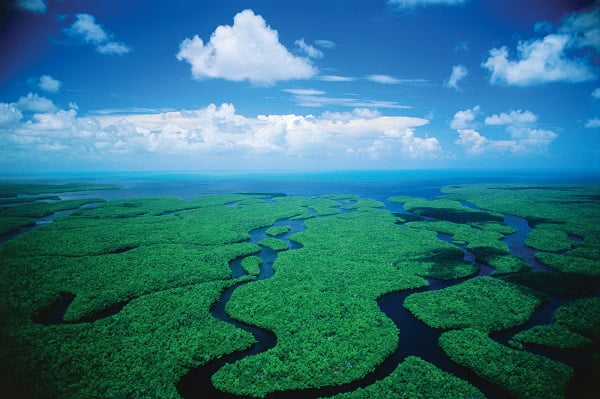
    Everglades National Park is a subtle place where earth, water, and sky blend in a low green landscape; where mere inches of elevation produce distinct changes in vegetation; and where a great wealth of birds and other wildlife find refuge. For this is almost exclusively a biological park dedicated to the preservation of a complex and precisely ordered living mechanism. It lies at the interface between temperate and sub-tropical America, giving a rich diversity of species, many at the limit of their ranges.

    The topography is so subdued that a broad sheet of water slowly flows over and through the porous limestone bedrock on its way to the sea, rather than following well-defined valleys. Most of the park is actually covered with water during normal wet seasons, while dry winters cause fresh water to dwindle to a few open areas crowded with wildlife.

    The great floral variety of the Everglades is one of the key resources of the park. Among its more prominent and colorful plants are Bromeliads and epiphytic orchids. As many as 25 varieties of orchids are known to occur in the park, in addition to over 1000 other kinds of seed-bearing plants and 120 species of trees. Over 36 threatened or endangered animal species reside in Everglades National Park, such as the American alligator (Alligator mississippiensis) and crocodile (Crocodylus acutus), the Florida panther (Felis concolor coryi), the West Indian manatee (Trichechus manatus), and the Cape Sable seaside sparrow (Ammodramus maritima mirabilis). Over 300 species of birds have been recorded, seven of which are rare or endangered.

    Protection of wading birds and their rookeries from commercial exploitation and encroachments was the prime reason for setting the park aside. Although habitat changes have reduced historic numbers, tens of thousands of birds feed and nest within the Everglades, providing visitors with opportunities of a lifetime for viewing them.

    With its special significance to the Nation and the world recognized by making the Everglades a National Park, an International Biosphere Reserve, a World Heritage Site, and a Ramsar Wetland of International Importance, its preservation for the benefit of present and future generations is better assured.

    International Biosphere Reserves

    International Biosphere Reserves are a project of the Man and the Biosphere program of the United Nations Educational, Scientific and Cultural Organization (UNESCO). Reserves are protected samples of the world's major ecosystem types. These sites are standards against which we can measure human impact on our environment and predict its probable effects. There are now over 190 reserves in 50 countries. Established for its biological values, Everglades National Park was added to this world list on October 26, 1976.

    World Heritage Sites

    World Heritage Sites are also designated by UNESCO under the Convention Concerning the Protection of the World Cultural and Natural Heritage. By the World Heritage Convention's 25th anniversary in 1997, nearly 150 nations had ratified the agreement and placed more than 500 sites on the World Heritage List.

    The Everglades, a subtropical mosaic of surprising diversity, is a refuge for 13 threatened or endangered animal species. Here, human history spans over 2000 years--from nomadic Calusa to modern settler. Because of this unique weave of natural and cultural history, Everglades National Park became a World Heritage Site on October 26, 1979.

    Ramsar Wetland of International Importance

    Known popularly as the "Ramsar Convention", the Convention on Wetlands, signed in Ramsar, Iran, in 1971, is an intergovernmental treaty which provides the framework for national action and international cooperation for the conservation and wise use of wetlands and their resources. There are presently 116 parties to the Convention, with 1005 wetland sites, designated for inclusion in the Ramsar List of Wetlands of International Importance.

    The Everglades was designated as a Wetland of International Importance on June 4, 1987.

    For more information on these international programs, visit these non-Everglades sites:


    Ecosystem

    The rock beneath this first national park created to protect a threatened ecological system is just 6,000 to 8,000 years old and in its infancy. South Florida surfaced only since the Ice Age. Nowhere do the Everglades landscape top eight feet above sea level. And like some low island, this subtropical region enjoys no source of water but the rains that fall on it. Everglades alone among our hemisphere's national parks holds three international designations: The International Biosphere Reserve, World Heritage Site, and Wetland of International Significance. Despite these designations, the Everglades and the endangered wood stork may die as well as others. Numbers of wading birds nesting in colonies in the southern Everglades have declined 93% since the 1930's - from 265,000 to 18,500. Migrating birds use Everglades National Park both as critical wintering areas and as a stopover. Species include the Cape May warbler, peregrine falcon, bobolinks, and tree swallows.

    The same rains that fall on south Florida today once ran off the backs of our wood stork's forebears, but the similarity ends there. Now, extensive canal and levee systems shut off the life-giving bounty of the rain before it can reach the national park, which makes up only one-fifth of the historic Everglades. At times the water control structures at the park boundary are closed, and no water nourishes the wood stork's habitat. Or, alternately, water control structures are opened and unnaturally pent-up, human- managed flood waters inundate Everglades creatures' nests or eggs and disperse seasonal concentrations of the wading birds' prey. Added to these problems is the presence of pollutants from agricultural run-off. High levels of mercury are identified in all levels of the food chain.

    Many animals are specifically adapted to the alternating wet and dry seasons. When human manipulation of the water supplies are ill-timed with natural patterns, disasters can results. Alligators build their nests at the high-water level. If more water is released into the park, their nests are flooded and destroyed. Endangered snail kite birds feed on the aquatic apple snail. Low-water conditions, human caused or natural, reduce snail and snail-kite populations. In the early 1960's only 20 to 25 snail kites remained in North America because of prolong drought. Snails lay eggs above the water in the wet season. If managers release more water, snails fail to reproduce.

    Given present trends, the endangered wood storks may no longer nest in South Florida by the year 2000. The wood stork has declined from 6,000 nesting birds to just 500 since the 1960's. Their feeding behavior explains their predicament. Wood storks feed not by sight, but by touch -"tacto-location"- in shallow and often muddy water full of plants. Fish can't be seen in those conditions. Walking slowly forward the stork sweeps its submerged bill from side to side. Touching prey, mostly small fish, the bill snaps shut with a 25- second millisecond reflex action, the fastest know for vertebrates. Only seasonally drying wetlands (mostly in drying ponds)concentrate enough fish to provide the 440 pounds a pair of these big birds requires in a breeding season. When natural wetlands cycles are upset by human water management, wood storks fail to nest successfully. The wood stork - which stands over 3 feet tall, and has a 5-foot wing spread, and weighs 4 to 7 pounds - was placed on the endangered species list in 1984.

    Native trees, such as mangroves and cypress, are being replaced by exotic (introduced) species from other countries. Florida largemouth bass share their nesting beds with tilapia and oscars, fish imported from Africa and South America. As the Everglades yield to human introduced plants and fish, native species diminish.

    Solutions are underway, but the fate of the Everglades still hangs in the balance. In one of the world's largest ecosystem restoration projects, Congress has extended the park boundaries to protect the eastern Shark River Slough. Historically it hosted higher concentrations of wading bird nesting populations than any other area in the park location. The enlargement should help turn around the 93 percent decline these species have suffered by restoring critical, suitable habitat. The National Park and the State of Florida have agreed to be partners in enforcing the existing water quality regulations to address water quality problems. The Park Service is working with the US Army Corps of Engineers and other water management jurisdictions to adopt natural rainfall models of manipulating water supplies.

    The park was established to save the 'Glades, but real problems continue to beset this landscape. Nothing is saved for good; the Everglades' fate remains our mandate.


    Ernest F. Coe - "Father of the Everglades"

    In 1928 Ernest F. Coe wrote Stephen T. Mather, first Director of the National Park Service, outlining a proposal for a national park to be located within the lower everglades of south Florida. A subsequent meeting took place and from this meeting legislation to create Everglades National Park was introduced by Senator Duncan B. Fletcher of Florida, in December of 1928. This legislation was approved May 25, 1934 and was signed by President Roosevelt on May 30, 1934. It took another thirteen years to acquire the land and define the boundaries of the new park.

    Ernest F. Coe, affectionately known as Tom by his friends, was born in New Haven, Connecticut, on March 21, 1866. He graduated from Yale University's School of Fine Arts in 1887. He and his wife Anna came to Miami in 1925. Their home was in Coconut Grove where he did landscape work. Anna died in July 1941.

    As a youngster Coe loved the out of doors, and as an adult he liked to explore the everglades. On these trips Coe was shocked to learn of rare birds being killed, rare or unusual orchids being taken from their natural habitat, and he feared that many animals would face extinction if something wasn't done. Coe was insistent that Florida should save its unparalleled tropical beauty. In 1928 he created the Tropical Everglades National Park Association (later Everglades National Park Association). As an official of this association he persistently and almost single handedly pushed for the establishment of the park. An inspection party came to Miami in 1930 to decide on areas for inclusion. One of those who participated was Marjory Stoneman Douglas, who would later write The Everglades: River of Grass, which has become a classic about the park and its conservation movement. He was ultimately successful and President Harry Truman dedicated the park in 1947.

    After Coe's death, on January 1, 1951, at age 84, Secretary of the Interior Oscar Chapman said, "Ernest Coe's many years of effective and unselfish efforts to save the Everglades earned him a place among the immortals of the National Park movement." On December 6, 1996, Everglades National Park christened its new visitor center the "Ernest F. Coe Visitor Center," in honor of this man who dedicated his life to the preservation of the everglades.


    Archeology

    Recent surveys in the Everglades and within the Big Cypress Swamp indicate the presence of at least several hundred archeological sites within the interior of South Florida. Some of these sites proved to be substantial, and suggest more than just marginal or short-term use. Based on current data, it also appears that the sawgrass plains region south of Lake Okeechobee, now the Everglades Agricultural Area, was a transitional area used for canoe travel and small encampments by many tribes. The exceptions are earthwork complexes, some of which are known to be located on the western edge of the Everglades. These sites show a strong affiliation with the Belle Glade Area on the shores of Lake Okeechobee. Pottery remains found in portions of the southwest section of the Everglades Agricultural Area indicate influence from regions as far away as Ten Thousand Islands/Florida Bay on the southernmost end of the state. The settlement of South Florida, which has occurred since 10,000 b.c., has been chronologically categorized up until a.d. 1930.

    Paleo-Indian Period (10,000 b.c. to 8000 b.c.)

    The Paleo-Indian likely lived with mammoths, bison, and other types of megafauna in arid climate conditions. With the extinction of these animals, the Paleo-Indian adapted to the changing climate and emerging wetlands and began to establish patterns of subsistence (deer and rabbit hunting, as well as marine life gathering).

    Archaic Period (8000 b.c. to 750 b.c.)

    During the Post Glacial period, the sea level rose and diminished Florida’s land base, and the climate began to change. By 5000 years ago, cypress swamps and hardwood forests characteristic of subtropical terrain began to develop. The people of this period increasingly relied on shellfish and other coastal resources, as well as expanded hunting, fishing, and plant gathering. From the Early Archaic Period to the Late Archaic Period, advances were made in the shaping and use of tools and pottery.

    The Glades Period (ca. 750 b.c. to a.d. 1500)

    The Glades I, II, and III periods are dated and characterized by pottery types. During the Glades II and III periods, evidences of a thriving trade network is evidenced by a variety of exotic resources, such as lithic tools and ornaments.

    Historic Contact Period (ca. a.d. 1500 to a.d. 1750)

    This period includes the arrival of the Europeans and their encountering of a thriving population of at least five separate tribes: the Tequesta in southeast Florida, the Calusa in the southwest, and the Jeaga and Ais along the east coast north of the Tequesta, and the Mayaimi near Lake Okeechobee. At the time of Spanish contact the Calusa maintained political dominance over these groups. It has been estimated that there were approximately 20,000 Indians in South Florida when the Spanish arrived. By 1763 when the English gained control of Florida, that population had been reduced to several hundred, which were reported to have migrated to Cuba with the Spanish (Romans 1962).

    Historic Period (ca. a.d. 1750 to a.d. 1930)

    There is little information on any pre-19th century activities in the area south of Lake Ockeechobee. With the demise of indigenous people in South Florida, and white settlement occurring to the north, increasing migrations of Creek peoples moved southward for hunting and settling. The Creeks and proto-Seminoles were in the area as early as the eighteenth century. During the Seminole Wars (1817–18, 1835–42, 1855–58) independent bands of Florida Indians established themselves in the Everglades to avoid removal from Florida.


    History

    At the end of the nineteenth century the south Florida coast was still largely wilderness, one of the last coastal regions east of the Mississippi to be settled. Only three small communities, Chokoloskee, Cape Sable and Flamingo, existed along the coast of what is now Everglades National Park.

    Early mariners knew about Cape Sable, located west of Flamingo as it appeared on their maps. It was here in 1838 that Dr. Henry Perrine was given a grant of land. Unfortunately his plans for a settlement did not materialize due to his untimely death at the hands of Indians. Another plan for settlement was proposed by Surgeon General Thomas Lawson who explored the Cape in 1838 for the U.S. government. He built Fort Poinsett on Cape Sable. In 1856 during the Third Seminole War, Fort Cross was established at Middle Cape.

    The town of Flamingo was established in 1893; its citizens had to choose a name in order to obtain a post office. According to records from the National Archives, Howell C. Low was the first postmaster. He was appointed on December 13, 1893. Cape Sable had its own post office and Jay L. Watrons was appointed postmaster on February 23, 1904.

    The 1910 federal census record shows 49 people living in Flamingo and Cape Sable. Most listed their profession as farming. There were ten heads of households, with 18 children and seven servants. Five people were cane farmers and one worked in charcoal making. (Charcoal was sold in 100 pound sacks at Key West.) Jobs that other individuals held were boatmen, farmer, hauling cane, cane farming (13) and one was retired. Many, if not all, fished for cash and food. Most also hunted. At the turn of the century plume hunting was a major source of cash income.

    Chokoloskee, near present-day Everglades City, was first settled in the 1870s, although it had been the home of Calusa Indians for centuries in pre-Columbian times. It became the trade center for homesteaders scattered throughout the Ten Thousand Islands region.

    Charles McKinney was Chokoloskee's first postmaster; he was commissioned on June 30, 1892. George Storter was commissioned as postmaster for Everglades on July 19, 1893.

    The 1910 census for Everglades township, including Chokoloskee Island, listed 144 people in 29 different households. Many were farmers or farm laborers. Of those, most were probably engaged in the labor-intensive growing of sugar cane. There was also one carpenter, a mail carrier, a wash woman, a sailor, and a school teacher.

    Two men made their livings as merchants, Charles "Ted" Smallwood and George Storter. The largest family, their name illegible in the records, had twelve members.

    The Everglade and Chokoloskee community was just recovering from a hurricane in 1909 when it was devastated by another, the worst on record, the following year. Only the highest ground of the old Calusa shell mound remained above water. Low-lying farm fields were salted by flood tides and most cisterns were polluted, a major tragedy in an area where few springs or wells existed. Many inhabitants of the outlying islands were forced to abandon their homesteads. The most infamous incident of the times, the vigilante murder of a local man suspected of several murders, occurred a few days after the hurricane. A somewhat fictionalized account of the event is told in the book Killing Mister Watson by Peter Matthiesson.

    In the early days the only way to arrive at Flamingo or Chokoloskee was by boat. Supplies were shipped from Key West, Fort Meyers or Tampa and cane syrup, fish, and produce were traded in return. Although neither town was ever to become a metropolis, they did have commerce, with some vegetables from Chokoloskee even reaching New York City.

    When Royal Palm state park was created in 1916, a road was built from Florida City to Royal Palm hammock. The Ingraham Highway, as it was eventually named, was later completed to Flamingo. The name highway gave more prominence to this road than it actually deserved. Often it could only be traveled in good weather and it was always full of ruts and mud holes. Early visitors could however enjoy the scenic Everglades as they traveled this road.

    Prosperity of a sort reached Everglades in the 1920s when Barron Collier made it his headquarters for the building of the Tamiami Trail across south Florida. It served as the county seat of Collier County until 1960, when prosperity waned and county offices were moved to Naples. Neighboring Chokoloskee did not have a road until a causeway was built from the mainland in 1956.

    Flamingo, still marking the end of the main park road, is now a park community with a campground, ranger station, marina and lodge. Chokoloskee, surrounded by park waters at the end of highway 29, is still home to fishermen, with a few motels and a resort having been added for park visitors. Although the tiny cane farms and fishing shanties are gone, both areas maintain the tranquil beauty for which they are famous.


    Geology

    The landscapes we see today in South Florida are a direct result of geologic events of the past. There is no place better to see this than in South Florida's National Parks. Here the geologic record is still fairly intact. Although the activities of humans have altered the landscape somewhat, the overall picture can still be seen.

    The rocks beneath the Big Cypress Swamp are among the oldest in South Florida. Six million years ago a shallow sea covered this area. Sediments of silt and sand and particles of calcium deposited on the bottom of this sea gradually cemented into limestone. Today this rock is called the Tamiami Formation.

    The Tamiami Formation is also found in the northwest corner of Everglades National Park. Here, fresh water flowing out of Big Cypress mixes with salt water from the Gulf of Mexico in a highly productive mangrove estuary. The resulting nutrient-rich soup supports a marine nursery for pink shrimp, snook, and snapper.

    Other rocks beneath the Everglades were formed during the time of the Great Ice Age. Although no glaciers developed in Florida, their effects were felt here. As glaciers in other areas of the world expanded, much of the earth's water supply was trapped in the ice. Sea levels in South Florida lowered as much as 300 feet below present levels.

    The Great Ice Age was actually four shorter ice ages with periods of warming in between. During these warmer "interglacial" stages, the ice melted and returned to the sea. The last interglacial stage occurred about 100,000 years ago. At its peak, the sea level in South Florida rose 100 feet above present levels.

    The rocks beneath the southeast section of the Park were formed in this sea. Calcium carbonate settling out of the water coated tiny bits of shell or sand in layer upon layer. The resulting spherical grains of limestone are called ooids. The Atlantic Coastal Ridge which runs from Mahogany Hammock northeast to Miami was formed as long shore currents pushed the ooids up into a long ridge. The ooids later cemented into rock known as Miami Oolite. Miami Oolite also covers most of the area east of Everglades National Park and most of Florida Bay.

    In quieter waters covering the central portions of the Park, tiny moss animals called Bryozoans flourished. As they died their calcium skeletons settled to the bottom. These sediments later cemented into rock known as the Miami Bryzoan Limestone.

    As in most areas of South Florida, subtle changes in elevation result in dramatic changes in vegetation communities. Pine forests are found on the high ground of the Atlantic Coastal Ridge. Where fire has been excluded, pines give way to hardwood hammocks. In wetter areas near the end of the ridge, dwarf pond cypress grow. South of the ridge sawgrass prairies take over again. A narrow band of mangroves fringe the southeast coast, and the shallow waters of Florida Bay today provide an abundant food supply for great numbers of wading birds.


    Endangered Species

    Threatened, endangered and extinct are words that have become all too common in our 20th century vocabulary. The natural process of species evolution, taking hundreds and thousands of years, has accelerated rapidly since the turn of the century. Today because of man's desire for land and raw materials, his continued pollution and indiscriminate hunting many plant and wildlife species are on the brink of extinction.

    Drainage of wetlands, alteration of overland water flow and hunting have all contributed to species decline. The Everglades, once known for its abundant bird life, has seen its wading bird population decline drastically since the turn of the century. The Florida Panther once common throughout the state, today is on the verge of extinction. Within the four National Park areas of Everglades National Park, Biscayne National Park, Big Cypress National Preserve and Fort Jefferson National Monument there are 16 endangered and 6 threatened wildlife species. The mere physical boundaries of a National Park do not guarantee a species survival.

    Maintaining harmony between "20th century progress" and wilderness areas requires research, legislation and public awareness. For the last decade the South Florida Research Center, Everglades National Park, has been studying how changes occurring outside the parks influence the fragile areas within their boundaries. Research going on today may lead to a brighter future for many species.

    Legislation such as the Endangered Species Act of 1973 has also afforded some measure of protection for wildlife. The Act provided for the classification of wildlife species as "endangered" or"threatened," and mandated legal protection for species so listed. In justification for such protection, the Act also recognized that the various species of fish, wildlife and plants have aesthetic, educational, historical and scientific value.

    Public support is also vital for species preservation. "What can I do?" you might ask. You can:

    Today it is not enough to merely appreciate nature, we have to actively work to protect it. What we do today toward that goal is the legacy we leave our children and their children. The extinction of a species is forever ... and the decision is ours.

    If you see any of the wildlife on this list or those you believe to be rare please fill out a wildlife observation card at any visitor center or report it to a ranger.

    - Written by Shirley Beccue

    Endangered Species in Everglades National Park:


    What is an endangered species?

    All of the endangered species in the Everglades are threatened by loss of habitat and alteration of water flow.

    What is an endangered species? Why are some species considered to be endangered? How do species become endangered? What contributes to this process? These basic questions must be considered by the youth of today if we are going to preserve our natural environment.

    An endangered species is a species of plant or animal that, throughout all or a significant portion of its range, is in danger of extinction. Everglades National Park is, or was at one time, home to fifteen endangered species. A sixteenth species, the Red-Cockaded Woodpecker, disappeared from the park in the 1940's.

    All of the rare and endangered species are threatened by loss of habitat and alteration of water flow to the park. The survival of these species is a major focus of the park's research effort. When active population management (such as captive breeding or reintroduction) is necessary, the Park Service joins forces with other wildlife agencies.

    The continued survival of the Everglades depends on careful, complimentary management pograms.

    Presently Endangered
    Butterflies: Schaus Swallowtail
    Rodents: Key Largo Cotton Mouse
    Key Largo Wood Rat
    Mammals: Florida Panther
    West Indian Manatee
    Birds: Arctic Peregrine Falcon
    Cape Sable Sea Side Sparrow
    Snail (Everglade) Kite
    Southern Bald Eagle
    Wood Stork
    Reptiles and Amphibians: American Crocodile
    Atlantic Ridley Turtle
    Green Turtle
    Hawksbill Turtle
    Leatherback Turtle


    The Panther originally occurred throughout most of the southeastern United States, but due to expanding urban development, it has been virtually eliminated. Panther sightings have been reported in some southeastern states, but probably do not exist in any of the eastern states except Florida. The Florida panther is a large, long-tailed, pale brown cat, which may be up to six feet (1.8 m) in length. The panther families usually contain only two or three young, and panthers breed only once every two or three years. Panthers are nomadic animals that have the ability to travel up to twenty miles (32 km) in one journey. They feed primarily on deer and wild hogs; however, some, particularly the younger cats, feed on smaller animals.

    State and Federal agencies have initiated studies to determine protection necessary for their survival. The Florida Panther Inter-agency Committee (FPIC), charts progress for protecting this animal. In 1986, scientists began collaring panthers with electronic tracking equipment to study their patterns. It was believed that in 1990, there were less than fifty surviving Florida panthers.

    They found that habitat destruction has been only partially responsible for the decline of the panther. The panthers' decline can also be attributed to genetic inbreeding, shootings, mercury poisoning, and the fact that many are killed along our highways due to high speed travel.

    The Manatee, or sea cow, is a massive, thick-skinned mammal with paddle-like forelimbs. It is grey-brown in color, weighs between 790 and 1,190 pounds (360 - 540kg), and is eight to fifteen feet in length (2.4 - 4.6m). Manatees inhabit slow-moving rivers, shallow estuaries, and salt water bays where they feed on aquatic vegetation. They are essentially gentle animals and have been used as agents for aquatic weed control.

    The survival of the manatee has been threatened due to propellers of boats, vandal attacks, poaching, and habitat destruction. Manatees are protected by the Endangered Species Act of 1973, and by the Marine Mammal Protection Act of 1972, although neither law protects them from boat propellers or vandals.

    The Wood Stork is a large, long-legged wading bird about 35 - 45inches long (89 - 114 cm) with a wing span of 60 - 65 inches (152 - 165cm). It is considered to be an "indicator species" in the Everglades. Why? This bird has rather specific habitat requirements and is closely related with the habitats of other species. Quality, quantity, timing, and distribution of water in its environment directly determine the well-being and number of this species as well as other species. Monitoring this selected species will reveal much about the health of the entire environment in which it lives.

    The wood stork is now endangered. It locates food with its bill by groping for small fresh-water fish in shallow water. This method of feeding is best when low water periods develop and the fish concentration increases. Although, due to modern water control programs, excessive drying patterns have created difficulties for the bird. By studying the wood stork, scientists have found that there is a decline in all wading birds in the park since the 1930's by at least 90%.

    The American Crocodile is a lizard-shaped reptile which ranges in length between nine inches (at hatching) to fifteen feet (23cm - 4.6m). The crocodile is slimmer than the alligator, and has a longer, more tapered snout. The crocodile feeds primarily on fish, although it is an opportunistic feeder and will eat almost any animal that comes into its territory. Crocodiles in Florida inhabit the coastal mangrove swamps, brackish and salt-water bays (including northern Florida Bay), creeks, and coastal canals.

    Most crocodiles, and their habitat from Biscayne Bay northward, have been lost due to human development along the coast and Keys. It is unlikely that many crocodiles will remain outside Everglades National Park in another ten years. These crocodiles can be maintained as long as there is proper protection and management by the National Park Service.

    Although only several of the endangered species in Everglades National Park have been mentioned, there is a common link between them. Man is partially responsible for their decline! The continued survival of the Everglades now depends on careful, complimentary management programs carried out by the National Park Service and other agencies. The public must also cooperate to make these programs a success. We must become aware and get involved!


    Habitats in Everglade national Park

    Slight changes in elevation (only inches), water salinity, and soil create entirely different landscapes, each with its own community of plants and animals.

    The Everglades is a low, flat plain shaped by the action of water and weather. In the summer wet season it is a wide, grassy river. In the winter season the edge of the slough is a dry grassland. Though Everglades National Park is often characterized as a water marsh, several very distinct habitats exist within its boundaries.

    Marine/Estuarine
    Florida Bay, the largest body of water within Everglades National Park, contains over 800 square miles (2072 square km) of marine bottom, much of which is covered by seagrass. The seagrass shelters fish and shellfish and sustains the food chain that supports all higher vertebrates in the bay. The hard bottom areas are home to corals and sponges.

    Mangroves
    Mangrove forests are found in the coastal channels and winding rivers around the tip of South Florida. Red mangroves (Rhizophora mangle), identified by their stilt-like roots, and the black (Avicennia germinans) and white mangroves (Laguncularia racemosa) thrive in tidal waters, where freshwater from the Everglades mixes with saltwater. This estuary system is a valuable nursery for shrimp and fish. During the dry months, wading birds congregate here to feed. Many bird species nest in the mangrove trees.

    Coastal Prairie
    Located between the tidal mud flats of Florida Bay and dry land, the coastal prairie is an arid region of salt-tolerant vegetation periodically flooded by hurricane waves and buffeted by heavy winds. It is characterized by succulents and other low-growing desert plants that can withstand the harsh conditions.

    Freshwater Marl Prairie
    Bordering the deeper sloughs are large prairies with marl sediments, a calcareous material that settles on the limestone. The marl allows slow seepage of the water but not drainage. Though the sawgrass is not as tall and the water is not as deep, freshwater marl prairies look a lot like freshwater sloughs.

    Freshwater Slough
    The slough is the deeper and faster-flowing center of a broad marshy river. This "fast" flow moves at a leisurely pace of 100 feet (30 meters) per day. Dotted with tree-islands called hammocks or heads, this vast landscape channels life-giving waters from north to south. Everglades National Park contains two distinct sloughs: Shark River Slough, the "river of grass;" and Taylor Slough, a narrow, eastern branch of the "river." There are no surface connections between the two. A series of other sloughs through the Big Cypress Swamp supply freshwater to western Florida Bay and the Ten Thousand Islands.

    Cypress
    The cypress tree (Taxodium spp.) is a deciduous conifer that can survive in standing water. These trees often form dense clusters called cypress domes in natural water-filled depressions. The trees in the deep soil at the center grow taller than those on the outside. Stunted cypress trees, called dwarf cypress, grow thinly-distributed in poor soil on drier land.

    Hardwood Hammocks
    Hammocks are dense stands of hardwood trees that grow on natural rises of only a few inches in the land. They appear as teardrop-shaped islands shaped by the flow of water in the middle of the slough. Many tropical species such as mahogany (Swietenia mahogoni), gumbo limbo (Bursera simaruba), and cocoplum (Chrysobalanus icaco) grow alongside the more familiar temperate species of live oak (Quercus virginiana), red maple (Acer rubum), and hackberry (Celtis laevigata). Because of their slight elevation, hammocks rarely flood. Acids from decaying plants dissolve the limestone around each tree island, creating a natural moat that protects the hammock plants from fire. Shaded from the sun by the tall trees, ferns and airplants thrive in the moisture-laden air inside the hammock.

    Pinelands
    The slash pine (Pinus elliottii var. densa) is the dominant plant in this dry, rugged terrain that sits on top of a limestone ridge. The pines root in any crack or crevice where soil collects in the jagged bedrock. Fire is an essential condition for survival of the pine community, clearing out the faster-growing hardwoods that would block light to the pine seedlings. Pine bark is multi-layered, so only the outer bark is scorched during fires. The pinelands are the most diverse habitat in the Everglades, consisting of slash pine firest, an understory of saw palmettos (Serenoa repens), and over 200 varieties of tropical plants.

    The Everglades estuary is an important "nursery" for many marine species. Where the Everglades "river" drains into the ocean there exists a rich environment, diverse with life. This environment is composed of saltwater marshes, mangrove islands, and a vast open bay. Florida Bay is an 850 square mile (2200 square km) estuary south of the Florida Peninsula. It is very shallow, with an average depth of only 4 to 5 feet (1.2 - 1.5 m). Beneath the cloudy brackish water is a layer of fine particles of mud. Rising out of the water are hundreds of small mangrove covered islands or keys.

    The two most important types of plants in this marine environment are mangroves and seagrasses. Shelter for many creatures is found among the tangled roots of the red mangrove or among the dense blades of the three species of seagrass which grow in the soft mud.

    The West Indian manatee and green sea turtle feed on seagrass. A second food chain begins when algae, growing on seagrass and mangrove roots, are eaten by a variety of small animals. A third is started when blades of seagrass or leaves of mangroves begin to decompose. As bacteria, fungus, protozoans, or nematodes consume these, a byproduct called detritus is formed. Detritus is an important food source for shrimp, lobsters, crabs, mollusks, worms, and small fish. These in turn are eaten by larger fish and many other species. The pink shrimp especially is an important food source for lots of fish. It is particularly vulnerable as it swims out to the Dry Tortugas, west of Key West, to its winter spawning grounds.

    Gamefish such as bonefish, tarpon, snook, red drum, and seatrout abound in these rich waters. Schools of grey snapper, which spend their days in nearby coral reefs, return each evening to forage for food. Over 100 species of marine fish have been identified in Florida Bay.

    Other species which call this area home include bonnethead, black tip, nurse, and hammerhead sharks. Stingrays hide in the soft mud and feed on mollusks and crustaceans. Atlantic bottlenose dolphin hunt for schools of silver or striped mullet.

    Some of the more unusual marine organisms include sponges, pipefishes, seahorses, sea cucumbers, horseshoe crabs, conchs, oysters, and the extremely rare american crocodile. The crocodile feeds on fish along the mangrove shorelines and, like the loggerhead turtle, lays its eggs on land in shell mounds.

    Everglades Setuary
    The Everglades estuary is an important "nursery" for many marine species. Without this protected area a 300 million dollar sports fishery (in and around the park) and a 100 million dollar commercial fishery, adjacent to the park, would be in jeopardy.

    Commercial fishing is prohibited in the park. Sport fishing is closely monitored and regulated. Both of these actions are an attempt to protect against overharvesting, maintain a sustainable breeding stock, and ensure a balanced ecosystem for future generations.

    Park researchers are concerned because thousands of acres of seagrass are dying in Florida Bay. This die off could seriously affect other members of the food chain. The cause of the die off is unknown. Theories point to several possibilities:

    Perhaps the problem is a combination of all of these theories. In any event, restoring the Everglades fresh water may be a key to preserving these marine species. Water conservation may prove vital to protecting this valuable resource.

    These marine species do not exist in a vacuum. They are affected by our actions. Careless fishermen tossing fishing line overboard can kill fish or turtles. Illegal netting of redfish removes key breeding stock from the population. Speeding in your boat can kill a manatee. Wasting water in Miami may cause more seagrass to die.

    Please be a responsible steward of the land and all its creatures. Learn about this estuary; then tell others. Take action in your own home to help protect all living species.

    Information provided by the National Park


    Everglades National Park Links
    Bullet Activity & Calendar Page
    Bullet Address & Phone
    Bullet Amphibian Guide
    Bullet Archeology
    Bullet Artist in Residence
    Bullet Bird Guide
    Bullet Biking
    Bullet Boating Guide
    Bullet Brochures, Maps, Written Info
    Bullet Chat Page
    Bullet Camping Guide
    Bullet Ecosystem
    Bullet Endangered Species
    Bullet Establishment
    Bullet Entrance Fees
    Bullet Fish Guide
    Bullet Fishing Guide & Regulations
    Bullet Flora and Fauna Guide
    Bullet Geology
    Bullet Hiking Guide
    Bullet History
    Bullet Insects Guide
    Bullet Jobs, SCA, Volunteer Positions
    Bullet Junior Ranger
    Bullet Location
    Bullet Lodging Guide
    Bullet Mammal Guide
    Bullet Map Guide
    Bullet Park Information
    Bullet Pet Information
    Bullet Permits
    Bullet Search
    Bullet Sights Guide
    Bullet Size and Visitation
    Bullet Reptile Guide
    Bullet Travel Guide
    Bullet Visitors Guide
    Bullet Weather
    Bullet World Park

    Everglades National Park
    Florida National Parks Page
    Back to National Parks


    by John William Uhler

    Copyright © 1995 - 2007 Hillclimb Media

    This site is in no way associated with the United States Government, the Department of the Interior or the National Park Service

    Demand Media Knowledge